
Temple
Gotokuji Temple: The Lucky Cat Temple in Setagaya
豪徳寺Gotokuji
A Soto Zen temple in Setagaya Ward, said to be one of the birthplaces of the lucky cat. Five minutes' walk from Miyanosaka Station. Open 6:00–17:00.
✓ 21 facts checked against official sources on November 23, 2026Next check: around May 2027
At a glance
- Time needed
- Allow about 1 hour to walk the grounds (estimate)
- Admission
- The official site does not list an entrance fee. Please check with the temple
- Opening hours
- Grounds 6:00–17:00; temple office (jimusho) 8:00–15:00
- Closed
- Not stated on the official site. Please check the site before you go
- Nearest station
- Miyanosaka Station on the Tokyu Setagaya Line, 5 minutes on foot; Gotokuji Station on the Odakyu Line, 15 minutes on foot
- Lucky cats
- Shofuku-neko (lucky cats) cost ¥500–¥10,000. Some sizes may be sold out
Gotokuji is a Soto Zen temple in Setagaya Ward, Tokyo. In the Edo period it was the family temple of the Ii family, the lords of Hikone, in Edo (old Tokyo).
The Setagaya Ward website says there is a theory that this is the birthplace of the maneki-neko (the "beckoning cat" you see in shops, with a raised paw). The temple calls its cats "manekineko" and they raise the right paw. They do not hold a koban (an old gold coin).
The grounds also have a Buddha hall from the Edo period, a three-storied pagoda and the Ii family graveyard, a nationally designated historic site. Cat lovers and history fans can both enjoy a walk here.
What to See
- Three-storied pagoda: It was completed in May 2006 and is 22.5 meters tall. You can see it as soon as you look up in the grounds. Inside are a statue of Shakyamuni and a statue of the cat-form Kannon, so it is worth a stop for anyone who likes photographing temple buildings.
- Buddha hall: It was built in 1677 and is a tangible cultural property designated by Setagaya Ward. You can look closely at this Edo-period building from outside. The statues inside are not open to the public, which history fans should keep in mind.
- Shofuku Hall: This is the hall that enshrines the lucky cats. It was built in 1941 (Showa 16) and renovated in 2022 (Reiwa 4). You can pray here for yourself and your family, and it is a good first stop if you are curious where the lucky cat story comes from.
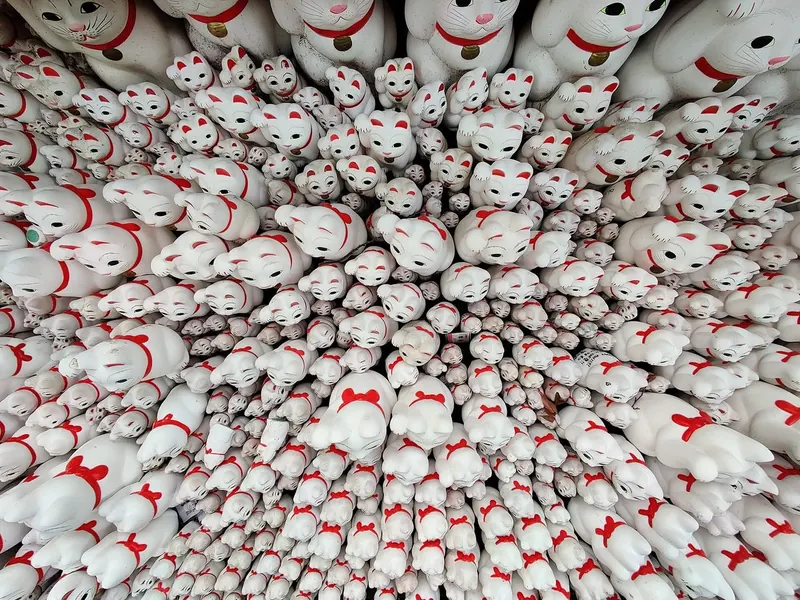
- Cat offering place (shofuku-neko hono-sho): Rows and rows of lucky cats stand here. The sight of so many cats with a raised right paw delights cat lovers and anyone who wants a photo. The temple says there is no special rule for offering a cat; most people bring one after a wish has come true.
- Temple office (jimusho): You can take home a lucky cat and other temple items here. It accepts visitors 8:00–15:00. Lucky cats cost ¥500–¥10,000, so if you want one as a souvenir, arrive before 15:00.
- Ii family graveyard: It is a nationally designated historic site with 303 gravestones in total. The grave of Ii Naosuke, the chief minister (tairo) at the end of the Edo period, is also here. Rows of large gravestones will appeal to anyone interested in the late Edo period. The official site does not explain visiting rules for the graveyard, so please follow the signs on site.
History
The temple began as Kotoku-in, founded in Bunmei 12 (1480). A temple legend says that Ii Naotaka, lord of Hikone, was passing the gate when a cat beckoned him inside. A thunderstorm followed and lightning struck, and he was saved.
Ii Naotaka restored the temple in Kan'ei 10 (1633). In Manji 2 (1659) the temple was renamed Gotokuji after his Buddhist name. Later the temple called the cat that brought good luck "shofuku-neko" and built Shofuku Hall to enshrine it.
Getting There
- Miyanosaka Station on the Tokyu Setagaya Line: 5 minutes on foot.
- Gotokuji Station on the Odakyu Line: 15 minutes on foot.
- If you come by car, please enter from the approach road (sando).
Tips for Visiting
- If you want to buy a lucky cat, go to the temple office first. It stops accepting visitors at 15:00, two hours before the grounds close.
- Lucky cats can be sold out. The temple says some sizes may not be available.
- The cat figures are sacred objects. The temple asks visitors not to write on them.
- A notice from August 2026 says that commercial guided tours, commercial filming and events in the grounds need to be discussed with the temple beforehand.
Point-and-show Japanese
| English | Japanese | Romaji |
|---|---|---|
| Please give me this lucky cat | この招福猫児をください | Kono manekineko o kudasai |
| Where is the temple office? | 寺務所はどこですか? | Jimusho wa doko desu ka? |
Basics (hours, prices, access)
Gotokuji Temple 大谿山 豪徳寺
The Ii family temple, said to be a birthplace of the lucky cat
The grounds have a hall full of lucky cats, a three-storied pagoda, a Buddha hall and the Ii family graveyard. You can take a lucky cat home from the temple office.
- Opening hours
- Grounds 6:00–17:00; temple office 8:00–15:00
- Closed
- Not stated on the official site
- Admission
- The official site does not list an entrance fee. Please check with the temple
- Access
- 5 minutes on foot from Miyanosaka Station (Tokyu Setagaya Line); 15 minutes on foot from Gotokuji Station (Odakyu Line)
- Phone
- 03-3426-1437
Before you go
- The temple office closes earlier than the grounds. If you want a lucky cat, go in the morning or early afternoon.
- The shortest walk is from Miyanosaka Station: just 5 minutes.
- Lucky cats are sacred objects. Please do not write on them.
Sources (official)
- Gotokuji Temple official site (Japanese)
- Gotokuji: About the temple (Japanese)
- Gotokuji: Gotokuji and the lucky cat (Japanese)
- Gotokuji: Temple items (Japanese)
- Gotokuji: Notice about writing on the lucky cats (Japanese)
- Gotokuji: Notice about commercial guided tours and activities (Japanese)
- Setagaya Ward: Gotokuji (Japanese)
- Setagaya Ward: Gotokuji Ii family graveyard, national historic site (Japanese)
- Setagaya Ward: Gotokuji Buddha hall statues (Japanese)