How to
Earthquakes and Typhoons in Japan: What to Do
In an earthquake, protect your head first and do not rush outside; near the coast, go to high ground. Typhoons come mostly from July to October. Install the free Safety tips app from the Japan Tourism Agency before you fly.
✓ 15 facts checked against official sources on November 18, 2026Next check: around May 2027
At a glance
- The short answer
- Earthquake: protect your head, take cover under a sturdy table, do not run outside, then follow staff. Near the sea: move to high ground at once
- Free app
- Safety tips (Japan Tourism Agency): earthquake, tsunami and weather alerts in 15 languages; iOS 13.0 or later, Android 5.0 or later
- Typhoon season
- About 11.7 typhoons come close to Japan a year, most in August and September (3.3 each), then July and October
- Warning levels
- Level 3: elderly people evacuate from dangerous areas; Level 4: everyone evacuates; Level 5: protect your life now
- Help in English
- JNTO Japan Visitor Hotline 050-3816-2787, 24 hours
Japan has many earthquakes, and most are small: you may feel a short shake in your hotel and nothing more. Buildings are built to resist them. What matters is knowing the first few actions so you do not panic, and getting alerts in a language you read.
Typhoons (tropical storms) bring strong wind and heavy rain, mostly in late summer and early autumn. For most visitors the main effect is on travel plans: trains, ferries and flights can stop while a typhoon passes.
The steps on this page follow the Japan Tourism Agency's Safety tips guide, the Japan National Tourism Organization (JNTO) and the Japan Meteorological Agency (JMA).
Before you go
- Install the Safety tips app. It is free from the Japan Tourism Agency, sends push alerts for earthquake early warnings, tsunami warnings and weather warnings, and has an evacuation flowchart and useful phrases. Download it from the Safety tips page and update it to the latest version.
- At check-in, find the emergency exits of your hotel and the evacuation route from your room.
- Keep your phone charged and carry a power bank.
- Buy travel insurance with enough cover before you leave. See Getting Sick in Japan.
Earthquake Early Warning: what the alarm means
- Phones, TV and radio sound an Earthquake Early Warning (緊急地震速報, kinkyū jishin sokuhō) just as an earthquake starts, before the strong shaking arrives.
- The time between the warning and the shaking is only a few seconds to a few tens of seconds. Near the centre of the quake, the shaking may come before the warning.
- When you hear it, stop what you are doing and protect your head at once.
During an earthquake: step by step
- In a hotel: protect your head and take shelter under a sturdy table. Do not run outside in a hurry; indoors may be safer.
- In a museum, shop, station or airport: protect your head and stay in an open hall area or near a pillar, away from things that can fall. Follow staff instructions.
- On the street: protect your head with a bag, watch for falling objects and keep away from buildings. Then move to an open space with other people.
- On a train: hold the handrail and protect your head; the train may brake hard. When it stops, follow the staff. Never step down onto the tracks on your own.
- In a lift (elevator): press all the floor buttons and get off at the first floor where it stops. If you are trapped, press the emergency call button and wait calmly for rescue.
- Driving a rental car: avoid sudden braking, pull over to the left side of the road and stop the engine. If you leave the car, keep the key in it and the doors unlocked, and call the rental company later.
After the shaking stops
- Open the door of your room so it cannot jam, and check the exits.
- Put out any open flames quickly; fire is the most dangerous secondary disaster.
- Follow the instructions of hotel or facility staff. Do not use lifts until staff confirm they are safe.
- Expect aftershocks (smaller quakes that follow). Stay alert for them.
- Check the Safety tips app or NHK WORLD-JAPAN for news in your language.
Tsunami: if you are near the sea or a river
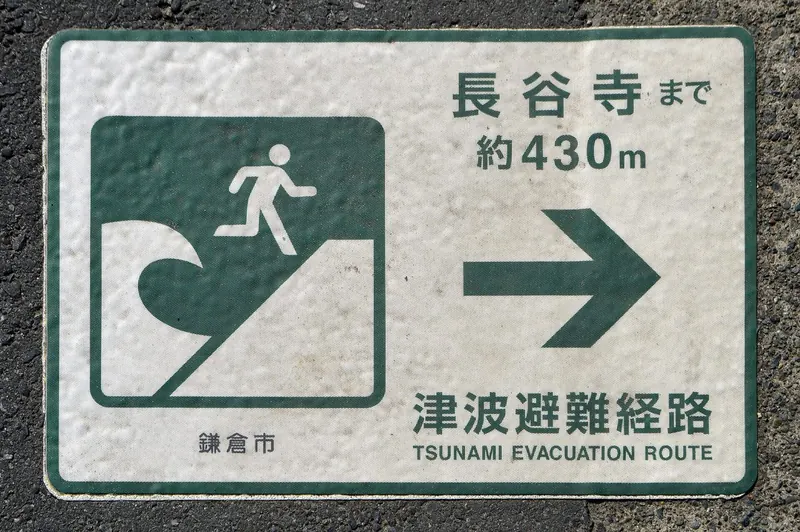
- Tsunami Advisory: get out of the water at once and move away from the shore. Tsunamis can come up rivers too.
- Tsunami Warning / Major Tsunami Warning: go to high ground or a tsunami evacuation building immediately. Watch what local people do and move with them.
- Tsunami waves come again and again. Do not go back to the shore until the warning is lifted.
Typhoons: when and what to do
Best months and seasons are explained on Best Time to Visit Japan and Japan Weather by Month.
- When: on average (1991–2020) about 25 typhoons form each year, about 11.7 come close to Japan and about 3 make landfall. Most come close in August and September, then July and October.
- Okinawa sees more typhoons close by than the main islands.
- Plans change: if a typhoon is coming, check your airline and railway, and keep a spare day at the end of your trip if you can.
- Stay inside while the storm passes. Do not go to the sea, rivers or mountain paths.
Weather warning levels
Travelers with a weak knee or who walk slowly should treat Level 3 as their signal to move, as the Safety tips guide says for elderly people.
- Level 2 (advisory): weather is getting worse. Check how you would evacuate.
- Level 3: there is a risk of disaster. Elderly people and others who need more time should leave dangerous areas now. Ask staff at a nearby facility.
- Level 4: high risk. Everyone should leave dangerous areas (riversides, slopes, low ground by the sea).
- Level 5 (emergency warning): a disaster is happening or about to. Act immediately to protect your life.
Shelters and help
- Evacuation shelters are usually schools and community centres. Some hotels and Japanese inns are also designated shelters.
- Help in English, Chinese and Korean: JNTO Japan Visitor Hotline 050-3816-2787, 24 hours a day, 365 days a year.
- Emergency numbers: 110 police, 119 fire and ambulance. See Is Japan Safe?.
Point-and-show Japanese
| English | Japanese | Romaji |
|---|---|---|
| Where is the evacuation shelter? | 避難所はどこですか? | Hinanjo wa doko desu ka? |
| Is it safe here? | ここは安全ですか? | Koko wa anzen desu ka? |
| Is the train running? | 電車は動いていますか? | Densha wa ugoite imasu ka? |
| Where is high ground? | 高い所はどこですか? | Takai tokoro wa doko desu ka? |
| I need help. | 助けてください。 | Tasukete kudasai. |
Before you go
- Install the Safety tips app before you leave home and allow notifications.
- At hotel check-in, find the emergency exits on your floor.
- In a quake, protect your head first; do not run outside.
- In typhoon season (July to October), keep one spare day before your flight home.
Sources (official)
- Japan Tourism Agency: The App 'Safety tips'
- Safety tips: When an earthquake occurs (in a hotel)
- Safety tips: At sightseeing, cultural and commercial facilities
- Safety tips: In an elevator
- Safety tips: Inside a vehicle
- Safety tips: Tsunami Advisory
- Safety tips: Level 3 Warning
- Safety tips: Level 4 Urgent Warning
- Safety tips for travelers (Japan Tourism Agency)
- JMA: Earthquake Early Warnings
- JMA: Typhoon normal values, 1991–2020 (Japanese)
- JNTO: Staying Safe in Japan