How to
Japan Weather by Month: Temperatures, Rain and What to Wear
Japan has four clear seasons. Tokyo averages 5.4°C in January and 26.9°C in August. The rainy season runs from early June to mid-July in Tokyo, Kyoto and Osaka, and typhoons are most likely in August and September.
✓ 14 facts checked against official sources on November 18, 2026Next check: around May 2027
At a glance
- Mildest months
- April–May and October–November: Tokyo averages 14–19°C in spring and 12–18°C in autumn
- Hottest month
- August: Tokyo averages 26.9°C, with average daily highs of 31.3°C
- Coldest month
- January: Tokyo averages 5.4°C; Sapporo averages -3.2°C
- Rainy season (tsuyu)
- Usually around 7 June to 19 July in Tokyo (Kanto); around 10 May to 21 June in Okinawa
- Typhoons
- Most often August and September; on average 3.3 typhoons come near Japan in each of those months
Japan is long from north to south, so the weather depends a lot on where you go. In January you can have deep snow in Sapporo (Hokkaido) and mild days of about 17°C in Naha (Okinawa). Tokyo, Kyoto and Osaka are in between and have four clear seasons.
The numbers on this page are the official 30-year averages (1991–2020) from the Japan Meteorological Agency (JMA). Real days can be much hotter or colder. Check the forecast a few days before you travel.
Two seasons need extra planning: the rainy season (tsuyu, early summer) and the typhoon season (late summer and early autumn).
Tokyo month by month
Average temperature, average daily high and low, and total rainfall (JMA, 1991–2020). The "What to wear" column is this guide's advice.
| Month | Average | High / Low | Rain | What to wear |
|---|---|---|---|---|
| January | 5.4°C | 9.8 / 1.2°C | 59.7 mm | Winter coat, sweater, scarf |
| February | 6.1°C | 10.9 / 2.1°C | 56.5 mm | Winter coat, sweater |
| March | 9.4°C | 14.2 / 5.0°C | 116.0 mm | Warm jacket, layers |
| April | 14.3°C | 19.4 / 9.8°C | 133.7 mm | Light jacket or cardigan |
| May | 18.8°C | 23.6 / 14.6°C | 139.7 mm | Long sleeves, light layer |
| June | 21.9°C | 26.1 / 18.5°C | 167.8 mm | Light clothes, umbrella |
| July | 25.7°C | 29.9 / 22.4°C | 156.2 mm | Light, breathable clothes, hat |
| August | 26.9°C | 31.3 / 23.5°C | 154.7 mm | Light clothes, hat, water bottle |
| September | 23.3°C | 27.5 / 20.3°C | 224.9 mm | Summer clothes, umbrella |
| October | 18.0°C | 22.0 / 14.8°C | 234.8 mm | Long sleeves, light jacket |
| November | 12.5°C | 16.7 / 8.8°C | 96.3 mm | Jacket, sweater |
| December | 7.7°C | 12.0 / 3.8°C | 57.9 mm | Winter coat |
Other cities: average temperature by month
Average temperature in °C (JMA, 1991–2020). Kyoto is a little colder than Osaka in winter and a little hotter in summer.
| Month | Sapporo | Kyoto | Osaka | Naha (Okinawa) |
|---|---|---|---|---|
| January | -3.2 | 4.8 | 6.2 | 17.3 |
| February | -2.7 | 5.4 | 6.6 | 17.5 |
| March | 1.1 | 8.8 | 9.9 | 19.1 |
| April | 7.3 | 14.4 | 15.2 | 21.5 |
| May | 13.0 | 19.5 | 20.1 | 24.2 |
| June | 17.0 | 23.3 | 23.6 | 27.2 |
| July | 21.1 | 27.3 | 27.7 | 29.1 |
| August | 22.3 | 28.5 | 29.0 | 29.0 |
| September | 18.6 | 24.4 | 25.2 | 27.9 |
| October | 12.1 | 18.4 | 19.5 | 25.5 |
| November | 5.2 | 12.5 | 13.8 | 22.5 |
| December | -0.9 | 7.2 | 8.7 | 19.0 |
| Year | 9.2 | 16.2 | 17.1 | 23.3 |
Yearly rainfall: Sapporo 1,146.1 mm, Kyoto 1,522.9 mm, Osaka 1,338.3 mm, Tokyo 1,598.2 mm, Naha 2,161.0 mm.
Spring (March–May)
- Cool mornings and mild days. In Tokyo the average high goes from 14.2°C in March to 23.6°C in May.
- Bring layers: a light jacket for the morning and evening, and a shirt for the afternoon.
- This is cherry blossom season. Dates by city are on Best Time to Visit Japan.
Rainy season (tsuyu, June–July)
- Tsuyu (梅雨) is a period of many cloudy and rainy days in early summer. It is not rain all day, every day, but you should carry an umbrella.
- Average start and end dates (JMA): Okinawa around 10 May to 21 June; northern Kyushu around 4 June to 19 July; Kinki (Kyoto, Osaka) around 6 June to 19 July; Kanto-Koshin (Tokyo) around 7 June to 19 July; northern Tohoku around 15 June to 28 July.
- JMA says the change into and out of the rainy season takes about five days on average, so the real dates move a little each year.
- It is warm and humid. Clothes that dry quickly and shoes that do not mind water are more comfortable than a heavy raincoat.
Summer (July–September)
- Hot and humid in most of Japan. In Kyoto and Osaka the average daily high in August is 33.7°C.
- Wear light, breathable clothes and a hat, and drink water often. Many sights (temples, gardens, old streets) are outdoors with little shade, so plan indoor breaks in the afternoon.
- Hokkaido is cooler: Sapporo averages 22.3°C in August.
- September is still hot in Tokyo (average high 27.5°C) and is also one of the rainiest months because of typhoons and autumn rain.
Typhoon season
- A typhoon is a strong tropical storm with heavy rain and wind. On average, 11.7 typhoons a year come close to Japan (within 300 km) and 3.0 make landfall.
- August and September have the most: on average 3.3 typhoons come close in each of these months. July (2.1) and October (1.7) also have some.
- When a typhoon comes, flights and trains (including the shinkansen) can be cancelled for a day or more.
- If you travel in August or September, keep one free day in your plan, and check the JMA warnings and your airline's notices. What to do is on Earthquakes and Typhoons in Japan.
Autumn (October–November)
- Comfortable temperatures. Tokyo averages 18.0°C in October and 12.5°C in November.
- October can still be rainy in Tokyo (234.8 mm on average). November is drier (96.3 mm).
- Bring a light jacket in October and a warmer jacket or sweater in November. Autumn leaves are on Best Time to Visit Japan.
Winter (December–February)
- Tokyo, Kyoto and Osaka are cold but often sunny, with average highs around 10°C. It rarely snows in these cities.
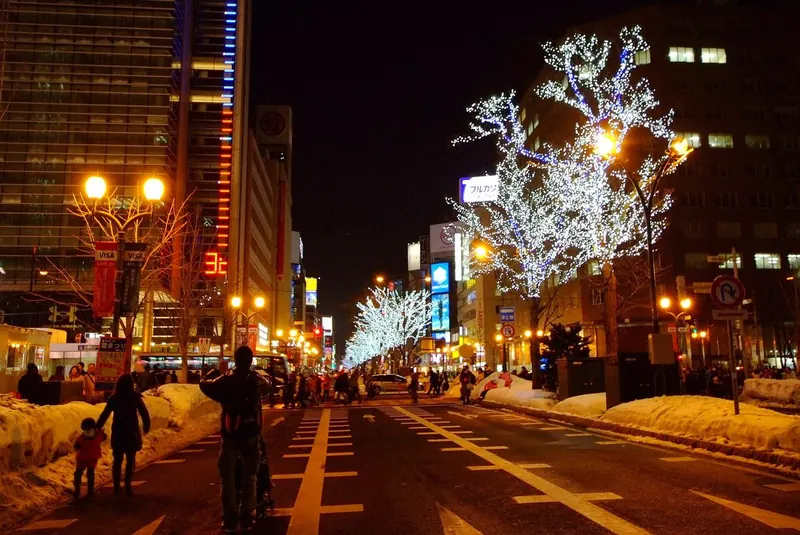
- Sapporo is below freezing on average in January (-3.2°C) and February (-2.7°C). Bring a heavy coat, gloves, a hat and shoes with good grip for icy streets.
- Naha (Okinawa) stays mild, about 17°C in January. A light jacket is enough.
- Indoors (trains, shops, hotels) is well heated, so layers you can take off are easier than one very thick sweater.
Things to know
- Averages hide hot and cold days. Some summer days are much hotter than the average high, so watch for heatstroke warnings and rest in the shade.
- Mountain areas (for example Hakone or Nikko) are colder than the cities near them. Bring one extra layer for day trips.
- Temperatures on this page are in degrees Celsius (°C). Japanese weather apps and TV also use Celsius.
Point-and-show Japanese
| English | Japanese | Romaji |
|---|---|---|
| Will it rain today? | 今日は雨が降りますか? | Kyō wa ame ga furimasu ka? |
| Where can I buy an umbrella? | 傘はどこで買えますか? | Kasa wa doko de kaemasu ka? |
| It is hot. | 暑いですね。 | Atsui desu ne. |
| Is the train running? | 電車は動いていますか? | Densha wa ugoite imasu ka? |
Before you go
- Cheap umbrellas are sold at convenience stores, so you do not need to pack a big one.
- In summer, convenience stores and vending machines sell cold water and sports drinks almost everywhere.
- What to pack for each season is on What to Pack for Japan.
Sources (official)
- Japan Meteorological Agency: Climate normals for Tokyo, 1991–2020 (Japanese)
- Japan Meteorological Agency: Climate normals for Osaka (Japanese)
- Japan Meteorological Agency: Climate normals for Kyoto (Japanese)
- Japan Meteorological Agency: Climate normals for Sapporo (Japanese)
- Japan Meteorological Agency: Climate normals for Naha (Japanese)
- Japan Meteorological Agency: Rainy season dates, Kanto-Koshin (Japanese)
- Japan Meteorological Agency: Rainy season dates, Okinawa (Japanese)
- Japan Meteorological Agency: Rainy season dates, Kinki (Japanese)
- Japan Meteorological Agency: Average number of typhoons by month (Japanese)
- JNTO: Weather and seasons in Japan