How to
Your First Konbini Onigiri: Salmon, Kombu and Tuna Mayo, How to Open One, and Where the English Is on the Label
Start with salmon, kombu or tuna mayo: about ¥200 (about $1.30) each at 7-Eleven. The English name is printed small under the price, and the opening steps are in English along the bottom of the wrapper.
✓ 19 facts checked against official sources on November 19, 2026Next check: around May 2027
At a glance
- Three good first choices
- Salmon (銀しゃけ), kombu (昆布) and tuna mayo (ツナマヨネーズ)
- Price at 7-Eleven
- ¥182–¥198 (about $1.20–$1.30) before tax (¥196.56–¥213.84 with tax)
- English on the label
- A small English name under the price, e.g. "Salmon", "Kelp in Soy Sauce", "Tuna Mayonnaise"
- How to open
- Pull tab 1 down and around, then pull corner 2 and corner 3 (steps printed in English on the wrapper)
- Allergens
- On 7-Eleven's product pages: salmon none of the 8 major allergens; kombu wheat; tuna mayo egg and wheat
- Eat by
- The use-by date and hour on the back sticker (消費期限), usually the next day
An onigiri is a ball of rice, usually a triangle, with a filling in the middle and a sheet of nori (dried seaweed) around it. Every convenience store (konbini) in Japan sells them, from early morning to late at night. It is the easiest cheap meal on a busy travel day.
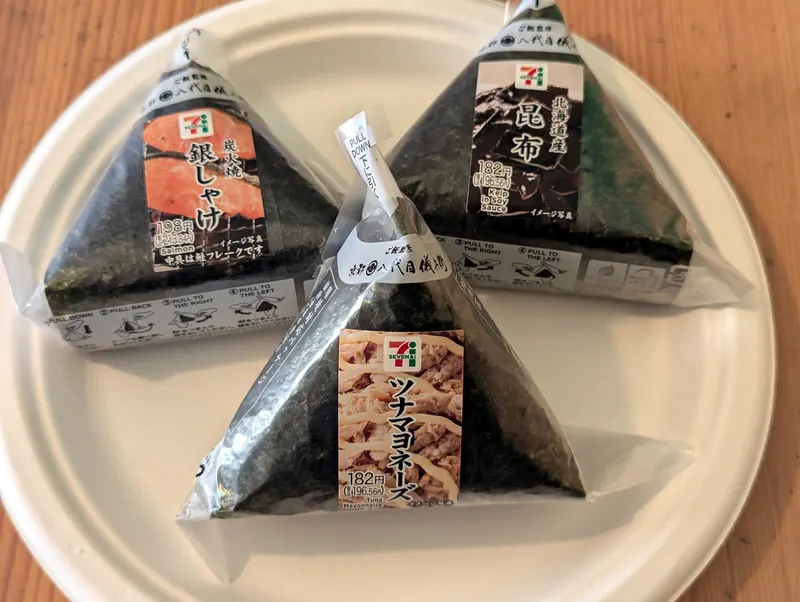
If it is your first time, start with salmon, kombu or tuna mayo. None of them is raw, none is spicy, and each costs about ¥200 (about $1.30). The photos on this page are of the three we bought at a 7-Eleven in November 2026.
Most labels look Japanese-only, but they are not. On 7-Eleven's wrapped onigiri, the English name is printed in small letters under the price, and the opening steps are printed in English on the strip at the bottom. This page shows where to look, then how to open one so the nori stays crisp.
The three to start with
These three are 7-Eleven's "temaki onigiri" (手巻おにぎり), the kind where the nori is kept in a separate layer of film, so it stays crisp until you open it. Prices and energy are from 7-Eleven's own product pages (stores in Kanto, including Tokyo).
| Big Japanese name | Small English name | What is inside | Price before tax | With tax | Energy | Major allergens (7-Eleven page) |
|---|---|---|---|---|---|---|
| 炭火焼 銀しゃけ | Salmon | Charcoal-grilled silver salmon, in flakes | ¥198 (about $1.30) | ¥213.84 | 182 kcal | None of the 8 |
| 北海道産 昆布 | Kelp in Soy Sauce | Kombu (kelp) from Hokkaido, simmered in soy sauce | ¥182 (about $1.20) | ¥196.56 | 171 kcal | Wheat |
| ツナマヨネーズ | Tuna Mayonnaise | Tuna mixed with mayonnaise | ¥182 (about $1.20) | ¥196.56 | 258 kcal | Egg, wheat |
If you can only pick one: tuna mayo is the most filling (258 kcal). Salmon is the plainest taste. Kombu is the sweetest and saltiest, and it is the one with no fish or meat in it.
Where the English is on the label
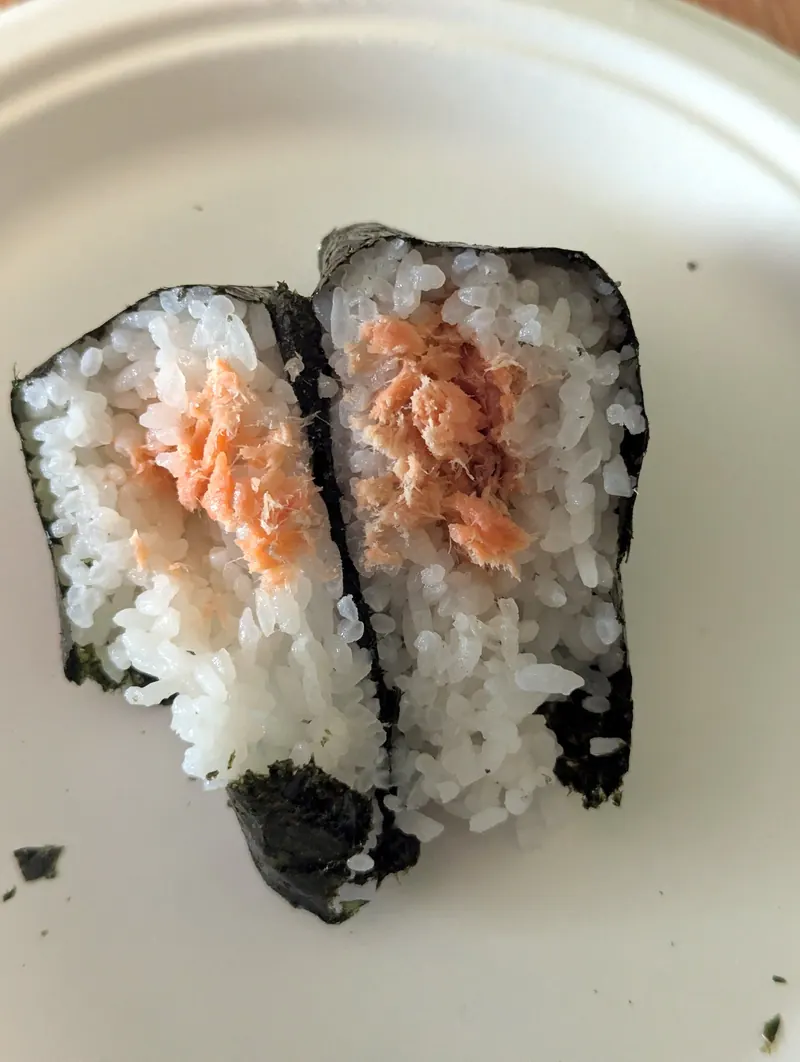
The salmon label has one more line in Japanese: 中具は鮭フレークです ("the filling is salmon flakes"). The picture shows a grilled fillet, but inside you get flaked salmon, as in the cut photo further down.
- The big Japanese name is in the middle of the front label: 銀しゃけ, 昆布 or ツナマヨネーズ.
- The price is just below it. The big number (e.g. 182円) is the price before tax. The small number in brackets, after 税込 ("zeikomi", meaning "tax included"), is what you pay: (税込196.56円). The register rounds your total to whole yen.
- The English name is in small letters right under the price: "Salmon", "Kelp in Soy Sauce", "Tuna Mayonnaise". It is easy to miss, so look just under the 円 sign.
- The opening steps are on the white strip along the bottom of the wrapper, in English and Japanese: ① PULL DOWN, ② PULL BACK, ③ PULL TO THE RIGHT, ④ PULL TO THE LEFT.
- The words イメージ写真 ("image photo") on the label mean the picture is only an image of the filling, not the real thing inside.
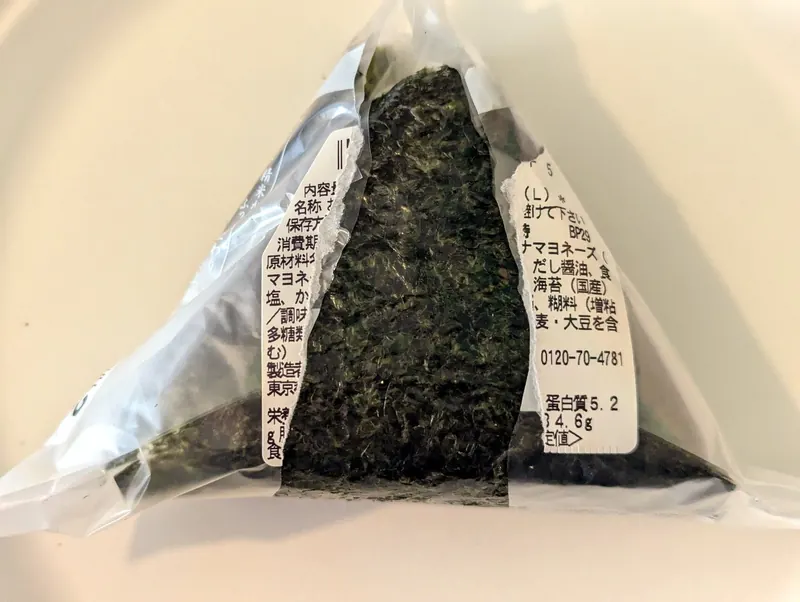
- The back sticker is only in Japanese. It has the ingredients, the allergens and the use-by time. See "Reading the back sticker" below.
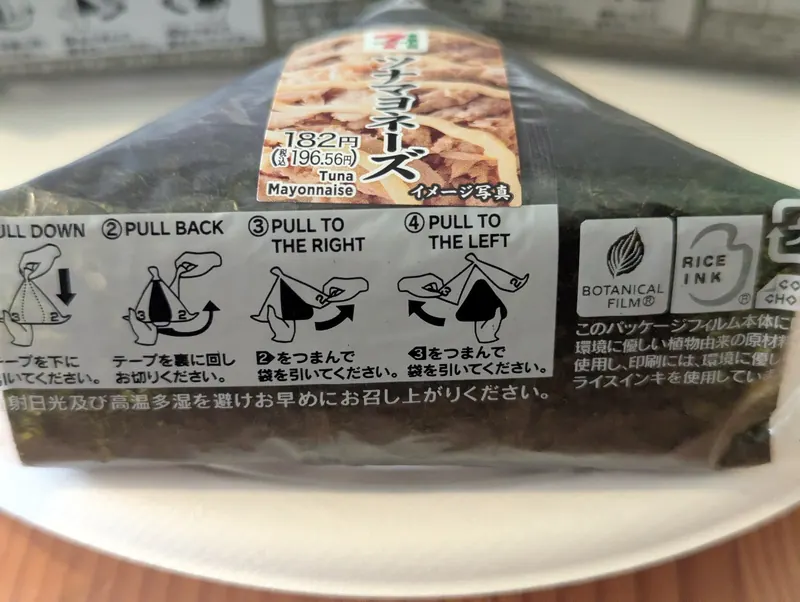
How to open it: 1, 2, 3
Pull slowly and keep the onigiri upright. If you pull the corners up instead of out to the side, the nori often tears and stays inside the film. A small torn piece is normal; you can still eat it with the rice.
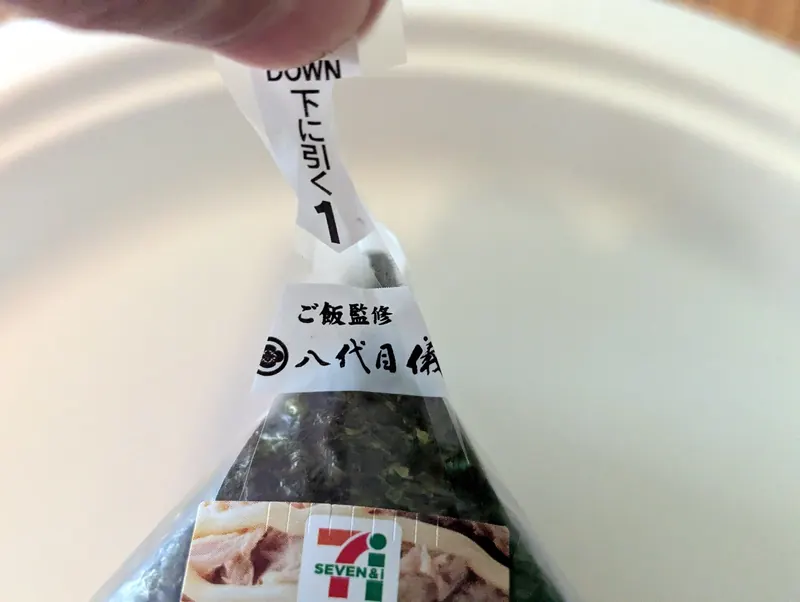
- Pull tab 1 down. Hold the onigiri with the point up. Take the small white tab marked 1 (PULL DOWN / 下に引く) at the top and pull it straight down the front. It tears the film in two.
- Pull the tape round the back and off. Keep pulling the tape down, under the bottom and up the back (PULL BACK), then tear it off. The film is now split down the middle on both sides.
- Pull corner 2 to the right. Pinch the corner marked 2 and pull that half of the film out sideways. The nori stays on the rice.
- Pull corner 3 to the left. Pinch the corner marked 3 and pull the other half out. Wrap any loose nori around the rice with your fingers, and it is ready to eat.
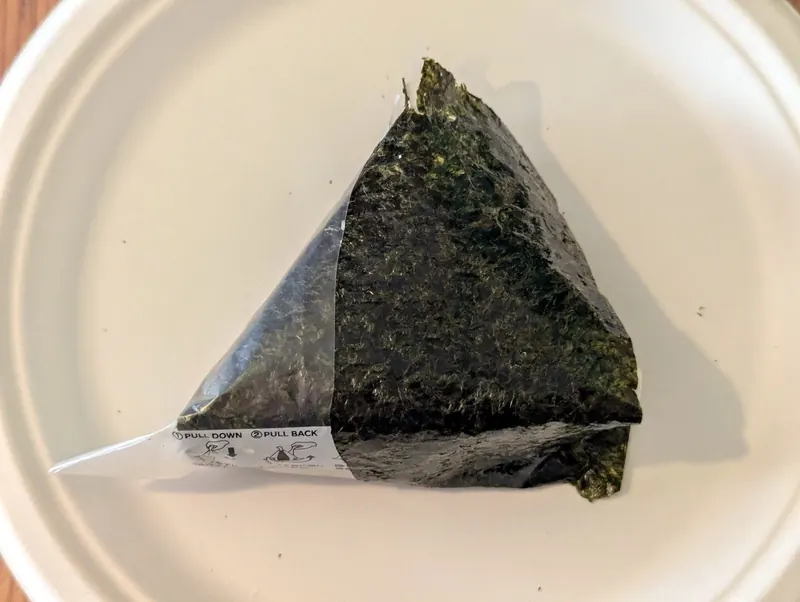
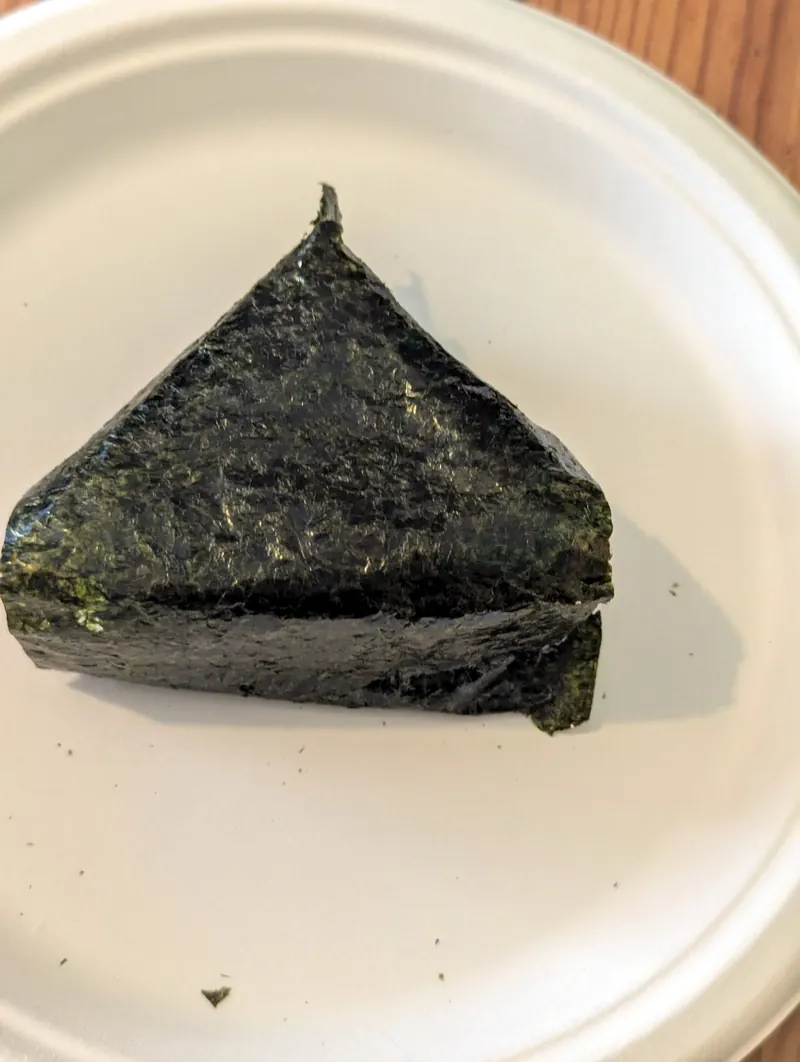
Salmon: 銀しゃけ (gin-shake)
銀しゃけ means silver salmon (coho salmon), and 炭火焼 (sumibiyaki) means charcoal-grilled. 7-Eleven describes the filling as silver salmon grilled over charcoal until fragrant. Inside you find pink flakes of cooked, salted salmon in the middle of the rice.
It tastes like a lightly salted grilled fish with plain rice. If you are not sure about Japanese food yet, this is the safest first bite. 7-Eleven's page lists none of the eight major allergens for it. Price: ¥198 (about $1.30) before tax (¥213.84 with tax).
Kombu: 昆布 (konbu)
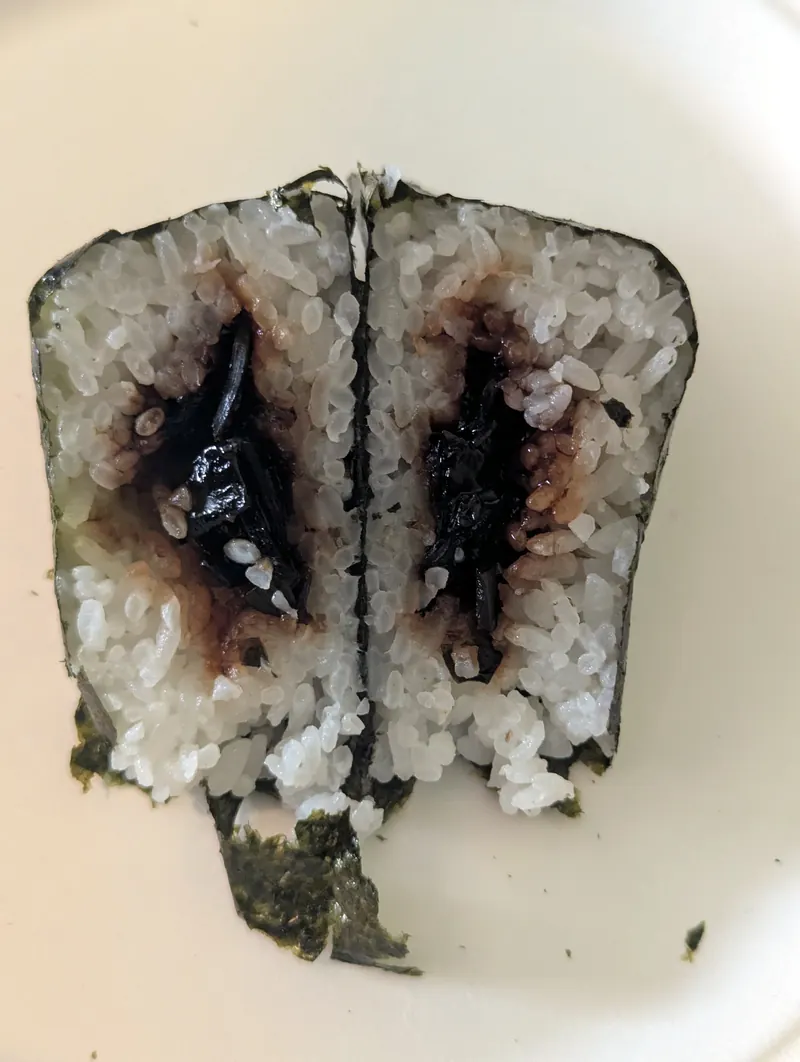
Kombu is a thick kelp (seaweed). Here it is cooked down in soy sauce into tsukudani (佃煮), a sweet and salty side dish that Japanese people often eat with rice. 北海道産 (Hokkaidō-san) on the label means "from Hokkaido", Japan's northern island. The English label says "Kelp in Soy Sauce".
Inside you see dark, glossy strips of kelp with a few sesame seeds, and brown soy sauce soaking into the rice around them. It has no fish or meat in it, but it does contain wheat (from the soy sauce), as 7-Eleven's page shows. Price: ¥182 (about $1.20) before tax (¥196.56 with tax).
Tuna mayo: ツナマヨネーズ (tsuna mayonēzu)
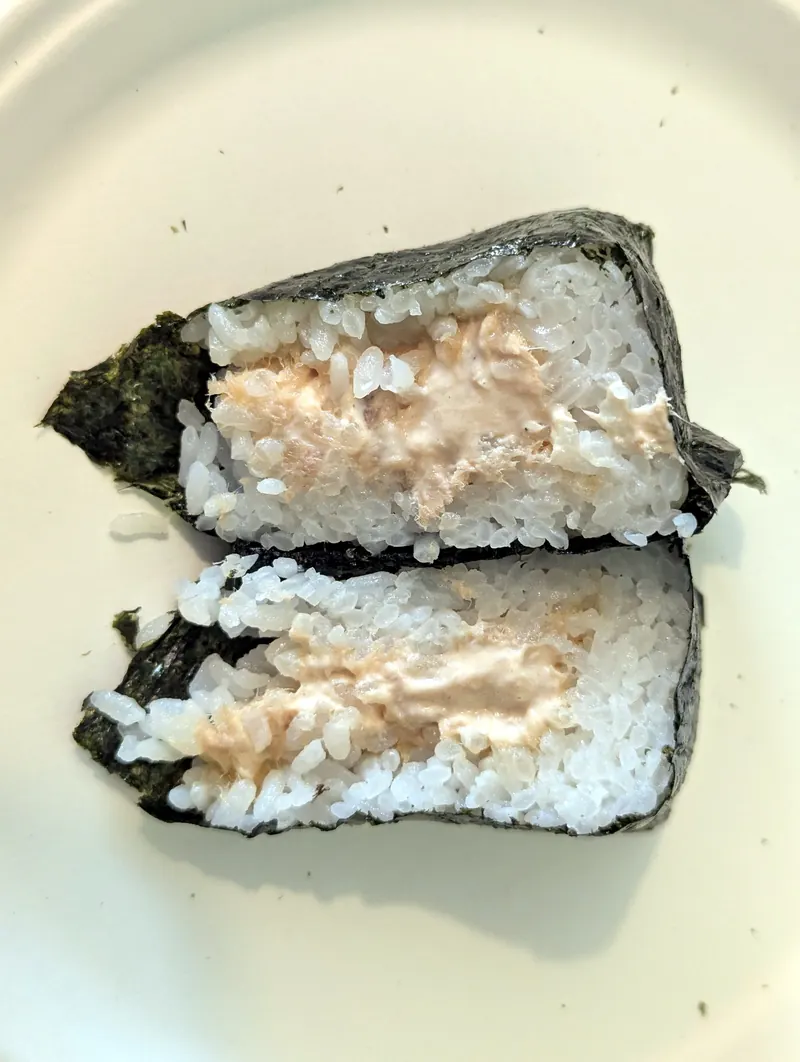
The name is just English written in Japanese letters: tuna mayonnaise. 7-Eleven describes it as tuna mixed with rich mayonnaise. Inside, the filling is soft and creamy, and it fills more of the rice than the other two.
One thing that surprises many visitors: the back sticker lists まぐろ・かつお (maguro and katsuo), so the "tuna" is a mix of tuna and skipjack (bonito). It also lists soy sauce and dried bonito powder. This is the onigiri to pick if you want something filling. It contains egg and wheat. Price: ¥182 (about $1.20) before tax (¥196.56 with tax).
Reading the back sticker: allergens and the use-by time
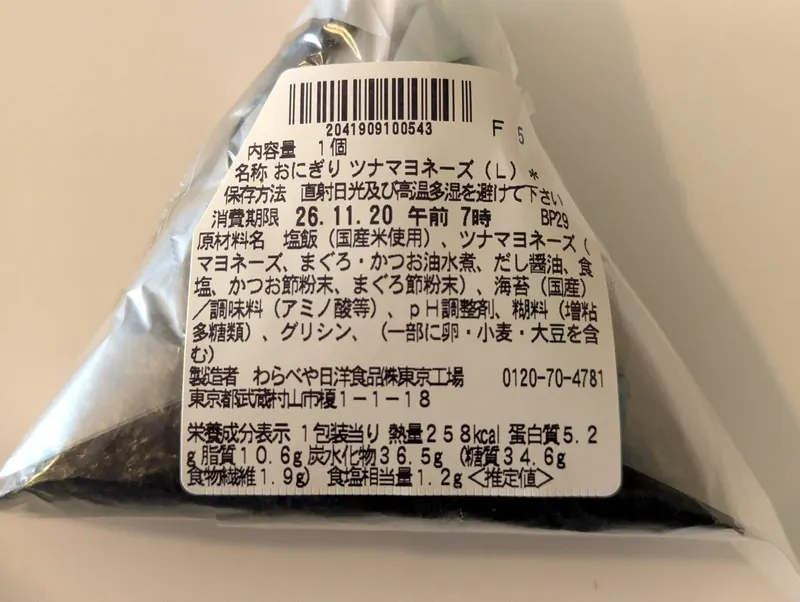
Turn the onigiri over: the white sticker on the back has the use-by time and the allergens. Here is what the stickers on our three said, next to 7-Eleven's product pages.
| Onigiri (English on the label / Japanese) | Price | Allergens on the sticker | 7-Eleven's "8 major allergens" | Use-by (消費期限) on our pack |
|---|---|---|---|---|
| Salmon / 銀しゃけ | ¥198 (about $1.30; ¥213.84 with tax) | さけ (salmon) | none | 26.11.20 午前7時 (7 a.m.) |
| Kelp in Soy Sauce / 北海道産 昆布 | ¥182 (about $1.20; ¥196.56 with tax) | 小麦 (wheat), 大豆 (soybeans) | wheat | 26.11.20 午後4時 (4 p.m.) |
| Tuna Mayonnaise / ツナマヨネーズ | ¥182 (about $1.20; ¥196.56 with tax) | 卵 (egg), 小麦 (wheat), 大豆 (soybeans) | egg, wheat | 26.11.20 午前7時 (7 a.m.) |
Allergens are as in the table. The sticker lists a few more than the eight major ones (salmon and soybeans are on the wider list), so if you are worried, look at the bracket 「一部に…を含む」 ("contains…") at the end of the ingredients. Other words you may see there: 乳 (milk), えび (shrimp), かに (crab), そば (buckwheat), 落花生 (peanuts).
The use-by time is on the line starting 消費期限: year (26 = 2026), month, day, then 午前 (a.m.) or 午後 (p.m.). Eat it before then. A camera translation app can read the rest of the sticker.
Finding them in the store
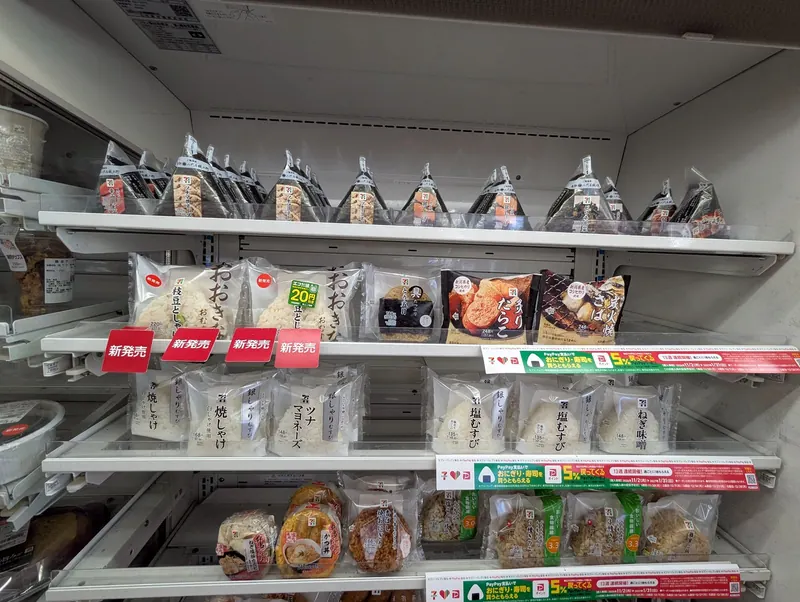
Onigiri are in the cold shelves, usually next to the sandwiches and bento boxes. The triangles wrapped in nori are the temaki onigiri on this page. In 2026 7-Eleven also started selling 銀しゃりむすび (gin-shari musubi), round onigiri with no nori, in clear packs; they are usually on a lower shelf.
Take the onigiri to the register. Staff will ask if you need a bag; you can answer with the phrases below. For how to pay, see Paying in Japan.
Things to know
- Prices change. 7-Eleven cut the salmon from ¥215 to ¥198 before tax on 8 September 2026, and prices of other flavors also change from time to time. Check the price on the label.
- Not every store has every flavor. The same name can be sold in one region and not another, and some regions have their own version (for example a different kombu in the Kansai area). 7-Eleven's onigiri list (Japanese) shows the sales region of each item.
- Eat it soon. The wrapper says to keep it out of direct sun, heat and humidity, and to eat it early (直射日光及び高温多湿を避けお早めにお召し上がりください). Do not leave it in a hot bag all day.
- The wrapper is plant-based in part. The marks on the wrapper are explained in 7-Eleven's 2021 announcement (Japanese): the film is made partly from the inedible parts of sugar cane (Botanical Film), and the print uses rice-bran ink (Rice Ink).
- Dollar amounts are rough guides at November 2026 exchange rates (about ¥150 = US$1); you pay in yen.
Point-and-show Japanese
| English | Japanese | Romaji |
|---|---|---|
| A bag, please. | 袋をお願いします。 | Fukuro o onegaishimasu. |
| I don't need a bag. | 袋はいりません。 | Fukuro wa irimasen. |
| Which one is salmon? | 鮭はどれですか? | Shake wa dore desu ka? |
| Does this have egg in it? | これに卵は入っていますか? | Kore ni tamago wa haitte imasu ka? |
| I'll pay by card. | カードでお願いします。 | Kādo de onegaishimasu. |
Before you go
- Look under the price for the small English name: that is the fastest way to know what is inside.
- Keep the onigiri point-up and pull the corners out to the sides, not upward, so the nori comes out in one piece.
- If you have a food allergy, read the bracket at the end of the ingredients on the back sticker: 卵 egg, 小麦 wheat, 大豆 soybeans, 乳 milk.
- The tax-included price (税込) is the one you pay; the big number is before tax.
Sources (official)
- 7-Eleven Japan: Temaki onigiri, charcoal-grilled silver salmon (Kanto and other regions) (Japanese)
- 7-Eleven Japan: Temaki onigiri, Hokkaido kombu (Japanese)
- 7-Eleven Japan: Temaki onigiri, tuna mayonnaise (Japanese)
- 7-Eleven Japan: List of temaki onigiri with sales regions (Japanese)
- 7-Eleven Japan: Price change for two temaki onigiri, 8 September 2026 (Japanese)
- 7-Eleven Japan: New temaki onigiri wrapper with Botanical Film and Rice Ink, 2021 (Japanese)