
Sight
Mount Yoshino, Nara: Cherry Trees on the Mountain
吉野山Yoshino-yama
A World Heritage mountain with about 30,000 cherry trees that bloom from the foot to the top. Here is when each area blooms and how to get there by train.
✓ 15 facts checked against official sources on November 24, 2026Next check: around May 2027
At a glance
- Time needed
- Most of a day (estimate)
- Admission
- No fee to enter the mountain is listed on the official pages
- Usual bloom
- Lower to upper areas: early to mid-April. Oku Senbon: mid to late April. Dates change every year.
- From Osaka
- About 1 hour 15 minutes by Kintetsu limited express
- From Kyoto
- About 1 hour 40 minutes by Kintetsu limited express, changing at Kashiharajingu-mae
- Nearest station
- Yoshino Station (Kintetsu Yoshino Line)
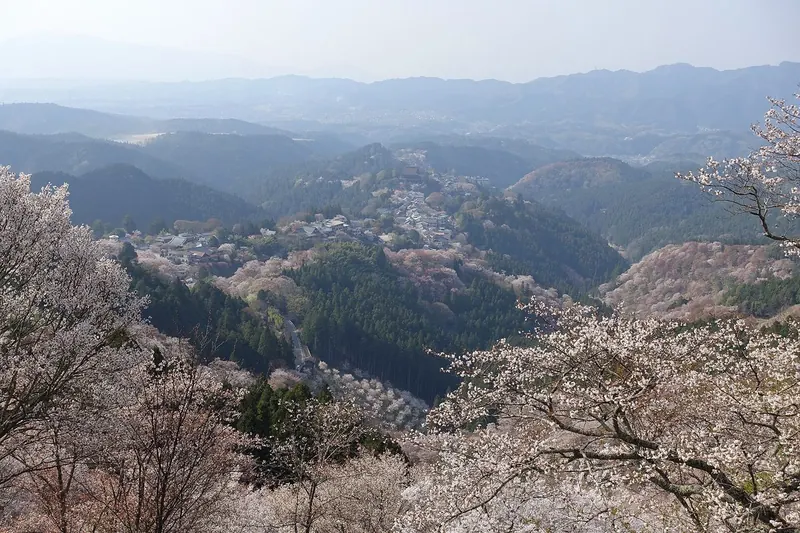
Mount Yoshino is in the south of Nara Prefecture. About 30,000 cherry trees of around 200 kinds grow here, and most are Shirayamazakura (white mountain cherry).
The trees are grouped into four areas up the mountain: Shimo Senbon (lower), Naka Senbon (middle), Kami Senbon (upper) and Oku Senbon (innermost). The blossoms climb the mountain as spring moves on, so the viewing season lasts longer than at a single park.
Bloom dates change every year. In spring, roads, buses and parking also run under special arrangements, so check the official Yoshino pages before you go.
What to See
- Shimo Senbon (lower area). This is the first area you reach from Yoshino Station, and it usually blooms in early to mid-April. You can walk up the winding Shichimagari path in about 20 minutes. It suits visitors who want blossoms without going far up the mountain.
- Naka Senbon (middle area). The middle slopes also usually bloom in early to mid-April. Kinpusen-ji, the temple at the heart of Yoshino's mountain worship, stands on the mountain and is part of the World Heritage site. Travelers interested in temples and history can combine it with the blossoms.
- Kami Senbon (upper area). Higher up, you look across slopes covered in trees. In spring 2026, the evening lighting included the cherry display garden here. Photographers who want a wide mountain view should allow time for this area.
- Oku Senbon (innermost area). The highest area usually blooms latest, in mid to late April. If the lower slopes have finished, you may still find flowers here. It is a good option for travelers arriving late in the season.
When the Cherry Trees Bloom
Nara Prefecture's tourism site gives early to mid-April for the lower, middle and upper areas, and mid to late April for Oku Senbon. In 2026, full bloom came on April 1 in Shimo Senbon, April 2 in Naka Senbon, April 4 in Kami Senbon and April 9 in Oku Senbon.
For reference, the Japan Meteorological Agency's average for Nara City is first bloom on March 28 and full bloom on April 4, based on 1991–2020. Yoshino is a separate mountain location, and its dates change every year.
History
Local tradition links the cherry trees to En no Gyoja, the founder of Shugendo (a Japanese mountain religion). He is said to have carved the deity Zao Gongen from cherry wood for Kinpusen-ji, and cherry trees came to be treated as sacred here.
In July 2004, the Sacred Sites and Pilgrimage Routes in the Kii Mountain Range, including Yoshino, became a UNESCO World Heritage site.
Getting There and Around
Road restrictions applied from March 20 to May 10 in 2026, and private cars could not book parking in advance. Travel by train if you can.
- Take the Kintetsu limited express to Yoshino Station. It is direct from Osaka Abenobashi (about 1 hour 15 minutes). From Kyoto, change at Kashiharajingu-mae (about 1 hour 40 minutes).
- From the station, walk up to Shimo Senbon (about 20 minutes uphill) or take the ropeway if it is running. It does not run in every season, so check first.
- In spring, special buses have run to Naka Senbon. In 2026, the one-way fare from Yoshino Station to Naka Senbon Park was ¥500. Check the 2027 schedule before you go.
Tips for Your Visit
- The climb from Yoshino Station to Oku Senbon has a large height difference. Wear good walking shoes.
- The tourist information office in front of Yoshino Station is open 9:00–16:00.
- We could not find published rules on picnics or parties. Follow signs on the mountain and take your rubbish with you.
Point-and-show Japanese
| English | Japanese | Romaji |
|---|---|---|
| Does this bus go to Naka Senbon? | このバスは中千本に行きますか? | Kono basu wa Naka Senbon ni ikimasu ka? |
| Is the ropeway running today? | 今日はロープウェイは動いていますか? | Kyō wa rōpuwei wa ugoite imasu ka? |
Basics (hours, prices, access)
Mount Yoshino (Yoshino Tourist Information Office) 吉野山
About 30,000 cherry trees climbing a sacred mountain
A World Heritage mountain with four cherry areas. The address given is the tourist information office in front of Yoshino Station, a practical starting point.
- Tourist office hours
- 9:00–16:00
- Tourist office closed
- None, except the New Year period
- Getting there
- Kintetsu limited express to Yoshino Station: about 1 hour 15 minutes from Osaka Abenobashi, about 1 hour 40 minutes from Kyoto
- Phone
- 0746-39-9237 (tourist information office)
Before you go
- Bloom dates change every year, so check the Yoshino official pages shortly before you go.
- If you come late in the season, head higher up the mountain.
- Go by train, because spring road restrictions can apply.
Sources (official)
- Yoshino cherry blossoms (Yoshino Visitors Bureau, Japanese)
- Cherry blossom information (Yoshino Visitors Bureau, Japanese)
- Tourist information offices (Yoshino Visitors Bureau, Japanese)
- Mount Yoshino (Nara Prefecture tourism, Japanese)
- Access (Yoshinoyama Tourism Association, Japanese)
- World Heritage (Yoshinoyama Tourism Association, Japanese)
- Spring light-up (Yoshinoyama Tourism Association, Japanese)
- Average first bloom dates (Japan Meteorological Agency, Japanese)
- Average full bloom dates (Japan Meteorological Agency, Japanese)