
Sight
Sensō-ji, Tokyo: Kaminarimon, How to Pray and Opening Hours
浅草寺Sensō-ji
Walk from Kaminarimon (Thunder Gate) along Nakamise to Hōzōmon and the main hall. This page covers what to see, how to pray, main hall hours and access.
✓ 14 facts checked against official sources on November 22, 2026Next check: around May 2027
At a glance
- Time needed
- About 1 hour (estimate)
- Admission
- The official website lists no admission fee. Check the official website for the latest information
- Main hall hours
- 6:00–17:00 (opens at 6:30 from October to March)
- Closed
- The official website lists no closing days
- Nearest station
- Asakusa Station (5 minutes on foot from the Tobu, Ginza Line and Tsukuba Express; 5 minutes on foot from Exit A4 of the Toei Asakusa Line)
Sensō-ji is one of the oldest temples in Tokyo. The temple says that a statue of Kannon appeared in 628, and that the priest Shōkai built a Kannon hall in 645.
The visit is simple. Go through Kaminarimon, walk about 250 meters along Nakamise, and pass through Hōzōmon to reach the main hall. The five-story pagoda and Yōkō-dō hall are nearby.
This is a Buddhist temple. The temple asks visitors to put their hands together and say “Namu Kanzeon Bosatsu” (南無観世音菩薩) when they pray.
What to see
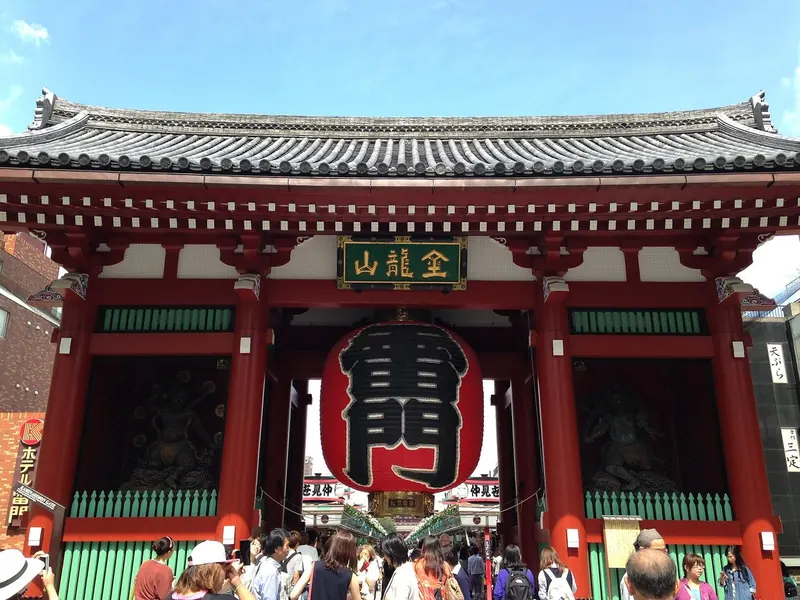
- Kaminarimon (Thunder Gate): its formal name is Fūraijin-mon. A large lantern 3.9 meters high and weighing about 700 kilograms hangs in the center. From in front of the gate you can photograph the lantern together with the statues of the wind god and thunder god on either side. It is a good first stop if this is your first trip to Tokyo and you want a souvenir photo.
- Nakamise: this approach road runs about 250 meters from Kaminarimon to Hōzōmon, lined on both sides with vermilion shops, so you can browse as you walk. Its origins go back to around 1685, and people who like old streets and history will enjoy walking it.
- Hōzōmon (Treasure House Gate): a two-story gate 21.7 meters high, guarded on both sides by Niō statues 4.54 and 4.93 meters tall. A giant straw sandal 4.5 meters high and weighing 500 kilograms, offered by Murayama City in Yamagata Prefecture, also hangs here. If you come with children, you can look for the sandal together.
- Main hall: it enshrines Shō-Kannon Bosatsu (the Sacred Kannon) and is 34.5 meters wide at the front. You can take off your shoes and step up onto the tatami (woven straw mat) floor of the inner sanctuary to pray, and look up at the ceiling painting of a dragon (龍之図) by Kawabata Ryūshi. If you like temple architecture or Japanese painting, it is worth spending more time here.
- Five-story pagoda: rebuilt in 1973, it stands about 53 meters above the ground, and the fifth floor holds Buddhist relics from Sri Lanka. You cannot climb the pagoda, so enjoy it from outside. It is an easy detour for people who like pagodas and photography.
- Yōkō-dō (影向堂): this hall on the west side of the grounds is the temple's goshuin (temple stamp) office. It enshrines Shō-Kannon Bosatsu and the guardian Buddhas of the twelve zodiac signs. Come here if you collect goshuin or want to find the guardian Buddha of your own zodiac sign.
How to pray
After you draw a fortune slip (Kannon Hyakusen), always return the stick to its container. If you draw a bad fortune, you can tie it at the designated place in the grounds. The official website does not give the price or the hours for fortune slips, so please check on site.
- Go first to the water pavilion (temizuya, called お水舎 at Sensō-ji). Take the ladle in your right hand and scoop water to wash your left hand.
- Switch the ladle to your left hand and wash your right hand.
- Switch back to your right hand, pour water into your left palm, and rinse your mouth with the water in your hand. Your mouth must not touch the ladle directly.
- Stand the ladle upright so the remaining water runs down the handle, then put it back.
- In front of the main hall, put your hands together and say “Namu Kanzeon Bosatsu” (南無観世音菩薩).
History
The temple records that the statue of Kannon appeared early in the morning of March 18 in the 36th year of Empress Suiko (628). In 645, the priest Shōkai came here and built a Kannon hall. In 942, Taira no Kinmasa built a large complex of seven halls.
Kaminarimon burned down in 1865 and was rebuilt in 1960 with a donation from Matsushita Kōnosuke. The present main hall was completed in 1958, Hōzōmon was rebuilt in 1964, and the five-story pagoda was rebuilt in 1973.
Tips for your visit
- The main hall opens 30 minutes later from October to March, so check the month before an early-morning visit.
- For the opening hours of halls other than the main hall, the official website asks visitors to inquire separately.
- The temple has no parking lot. Please go by train or bus.
- There is an elevator on the left side of the main hall, and there are accessible toilets next to Hōzōmon and behind the main hall. They help when you travel with older relatives or a stroller.
Point-and-show Japanese
| English | Japanese | Romaji |
|---|---|---|
| Where is the goshuin office? | 御朱印所はどこですか? | Goshuinjo wa doko desu ka? |
| What time does the main hall close? | 本堂は何時に閉まりますか? | Hondō wa nanji ni shimarimasu ka? |
Basics (hours, prices, access)
Sensō-ji 浅草寺
An old Tokyo temple, from Kaminarimon to the main hall
Pass through Kaminarimon and Nakamise to reach the main hall, which enshrines Shō-Kannon Bosatsu. The grounds also have Hōzōmon, the five-story pagoda and Yōkō-dō.
- Main hall hours
- 6:00–17:00 (opens at 6:30 from October to March)
- Other halls
- Ask the temple for the hours
- Admission
- Not listed on the official website; please check it
- Access
- 5 minutes on foot from Asakusa Station (Tobu Skytree Line, Tokyo Metro Ginza Line, Tsukuba Express); 5 minutes on foot from Exit A4 of Asakusa Station (Toei Asakusa Line)
- Phone
- 03-3842-0181 (except Sundays and holidays, 9:00–16:30)
- Address
- 東京都台東区浅草2-3-1
Before you go
- Main hall hours change with the month. From October to March it opens at 6:30.
- At the main hall, put your hands together and say “Namu Kanzeon Bosatsu”.
- On December 13 at 2 p.m. there is a Gokaihi ceremony, when the Gozen-dachi Honzon, which is normally not on view, is open for prayer.
Sources (official)
- Sensō-ji official website (Japanese)
- Sensō-ji: origin and history (Japanese)
- Sensō-ji: etiquette at the water pavilion (Japanese)
- Sensō-ji: FAQ (Japanese)
- Sensō-ji: Kaminarimon (Japanese)
- Sensō-ji: Nakamise (Japanese)
- Sensō-ji: Hōzōmon (Japanese)
- Sensō-ji: main hall (Japanese)
- Sensō-ji: five-story pagoda (Japanese)
- Sensō-ji: Yōkō-dō (Japanese)