How to
Taxis and Ride-Hailing in Japan: Fares, How to Hail and Apps
タクシーtakushī
In Tokyo a taxi starts at 500 yen for the first 1.0 km. A 7 km ride takes about 25 minutes and costs about 2,500–3,000 yen in the daytime. Do not tip. The rear door opens and closes by itself.
✓ 14 facts checked against official sources on November 18, 2026Next check: around May 2027
At a glance
- Starting fare (Tokyo)
- 500 yen for the first 1.0 km, then 100 yen for every 232 m (23 wards, Musashino and Mitaka)
- Example
- 7 km in Tokyo, about 25 minutes: about 2,500–3,000 yen in the daytime
- Late night
- 10 p.m.–5 a.m.: 20% more
- Tipping
- Not needed. Drivers do not expect or accept tips.
- Payment
- Most Tokyo taxis take credit cards. In the countryside, carry cash.
- Apps
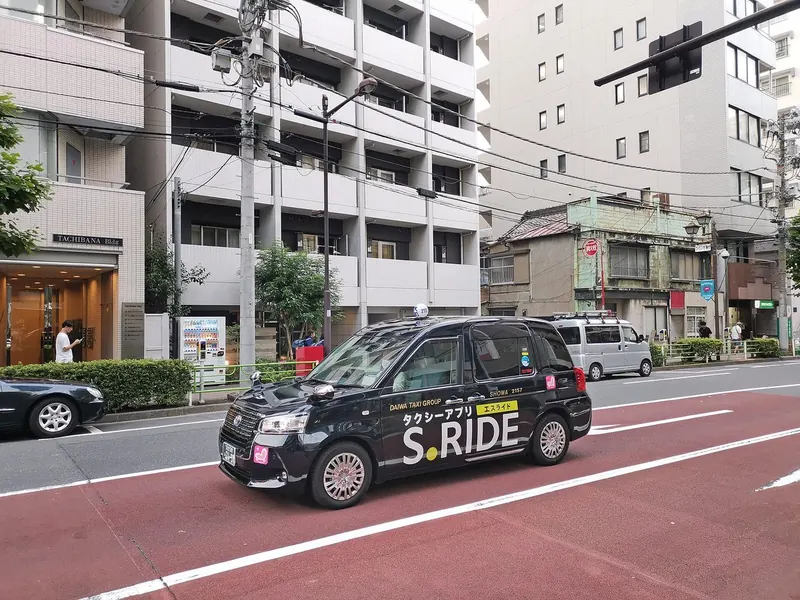
- GO, S.RIDE, Uber and DiDi offer English service
In Japan the taxi fare is set by the meter, and meters are strictly regulated by law and inspected every year. The rear door opens and closes automatically, so you do not touch it. Smoking is not allowed in most Tokyo taxis.
Taxis cost more than trains, but they are worth it for short trips with luggage, late at night when trains have stopped, or for a group of three or four. Many drivers speak little English, so have your destination written in Japanese or ready in an app.
From the airports there are fixed fares to central Tokyo. See Narita Airport to Tokyo and Haneda Airport to Tokyo.
Fares
Fares are set by region. These are the standard-size taxi fares of the Tokyo Hire-Taxi Association for the 23 wards of Tokyo, Musashino and Mitaka.
| Item | Price | Notes |
|---|---|---|
| Starting fare | 500 yen | Up to 1.0 km |
| Distance | 100 yen | For every additional 232 m |
| Slow traffic | 100 yen | Every 1 minute 25 seconds when the taxi moves at less than 10 km per hour |
| Late night, early morning | +20% | 10 p.m. to 5 a.m. |
| Long rides | 10% off | On the part of the fare over 9,000 yen |
| Expressway tolls | Extra | The passenger pays the tolls |
Example (from JNTO): a 7 km ride in Tokyo that takes about 25 minutes costs about 2,500–3,000 yen in the daytime.
In Kyoto, the Kyoto taxi association uses a standard fare of 500 yen to start, then 100 yen every 255 m. If you call a taxi to come to you, an extra pickup charge may be added; each company sets its own.
How to catch a taxi on the street
At stations and big hotels, use the taxi stand (taxi noriba) and wait in line. In Ginza in Tokyo, from 10 p.m. to 1 a.m. on weekdays, taxis may only pick up passengers at the official taxi stands.
- Look for a taxi with a red sign in the windshield. In Tokyo, red means the taxi is free. Green means it has a passenger.
- Raise your hand when it comes near. The taxi stops by the side of the road.
- Wait for the rear door to open by itself. Do not open or close it.
- Get in the back and show the driver your destination: an address in Japanese, a hotel name, or a map pin on your phone.
- Fasten your seat belt. Check that the meter starts.
- At the end, pay the amount on the meter by credit card or cash. Ask for a receipt (ryōshūsho) if you want one.
- The door opens by itself. Check the seat for your phone and bags before you get out.
Taxi apps
With an app you set the pickup point and the destination on a map, so you do not need to explain in Japanese. You can also pay in the app. For other useful apps, see Useful Apps for Japan.
- GO: Japan's taxi app. It works in all 47 prefectures and accepts international credit cards and Apple Pay. See the GO website.
- Uber: in Japan, Uber is used to call licensed taxis. Uber lists taxi service in cities such as Tokyo, Kyoto, Osaka, Fukuoka, Sapporo, Sendai, Hiroshima and Okinawa. See Uber Japan.
- S.RIDE and DiDi: two more taxi apps that JNTO lists as having English service.
Things to be careful about
- Do not tip. The Tokyo Hire-Taxi Association and JNTO both say tips are not necessary. Uber's app has a tip button, but it is your choice.
- Countryside: credit cards are widely accepted in big-city taxis, but in rural areas cash may be the only way to pay. Carry enough yen; see Money in Japan.
- Late at night: after the last train, taxi lines at big stations can be long. Fares are 20% higher from 10 p.m. to 5 a.m.
- Write the address in Japanese if your destination is not a famous place or a large hotel. A hotel card with the address is the easiest.
- Expressway: if the driver asks whether to use the expressway (kōsoku), the tolls are added to your fare.
Point-and-show Japanese
| English | Japanese | Romaji |
|---|---|---|
| To this address, please. | この住所までお願いします。 | Kono jūsho made onegai shimasu. |
| Please stop here. | ここで止めてください。 | Koko de tomete kudasai. |
| Can I pay by credit card? | クレジットカードで払えますか? | Kurejitto kādo de haraemasu ka? |
| A receipt, please. | 領収書をお願いします。 | Ryōshūsho o onegai shimasu. |
| Please open the trunk. | トランクを開けてください。 | Toranku o akete kudasai. |
| Please do not use the expressway. | 高速道路は使わないでください。 | Kōsoku dōro wa tsukawanaide kudasai. |
Before you go
- Save your hotel's name and address in Japanese on your phone. Show it to the driver at the end of the day.
- For three or four people going a short distance, a taxi can cost about the same as train tickets for everyone.
- Signs in the windshield are usually in Japanese, so look at the color: red is free, green is taken (Tokyo).