How to
Souvenirs by Region: The Classic Sweet from Hokkaido, Tokyo, Kyoto, Hiroshima, Fukuoka and Okinawa, and Where to Buy It
Every region of Japan has a sweet that people bring home in a neat box. Here are six classics, what they are, and the makers' own shops where you can buy them.
✓ 12 facts checked against official sources on November 2, 2026Next check: around May 2027
In Japan, coming home from a trip means bringing omiyage: a box of local sweets, individually wrapped, to share with family and coworkers. Because of this custom, almost every region has a famous sweet, and you will see stacks of them at the main station and the airport.
This guide covers six of the best known, one per region, with the maker's own shops. Prices change, so check the maker's site before you go. For buying tax-free, see our tax-free shopping guide.
Hokkaido: Shiroi Koibito
Shiroi Koibito ("white lovers") from ISHIYA is Hokkaido's best-known sweet: white chocolate between thin, crisp langue de chat cookies. It turned 50 recently and has a new look.
Where to buy: Shiroi Koibito Park in Sapporo, where the factory is, has its own shop (Shop Piccadilly, 2-2-11-36 Miyanosawa, Nishi-ku) with park-only items. ISHIYA's flagship store in Sapporo's Odori area also sells it.
Tokyo: Tokyo Banana
Tokyo Banana is a soft sponge cake filled with banana cream, sold in many shapes and character versions. There are versions you can buy only in one place: the honey-banana "flying bear" (Sora Tobu Tokyo Banana Kumassu) is sold only at Haneda Airport, at ¥756 for 4 or ¥1,404 for 8.
Where to buy: Tokyo Station, Haneda Airport and department stores across Tokyo. The maker's store search lists which shops carry which version.
Kyoto: Yatsuhashi
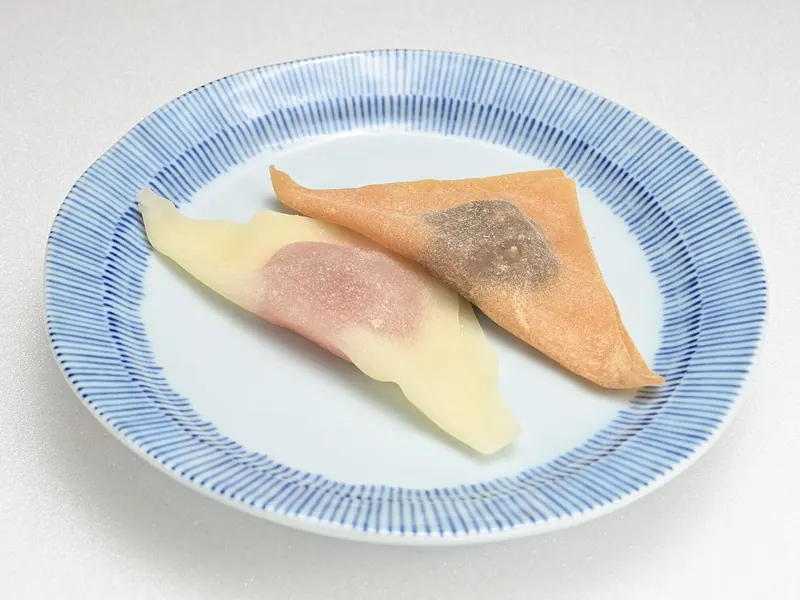
Yatsuhashi is Kyoto's signature sweet. It comes two ways: baked, a crisp cinnamon cracker shaped like a curved roof tile; and nama (raw), a soft, chewy rice-flour sheet folded around sweet red bean paste. Shogoin Yatsuhashi Sohonten says it was founded in 1689 (Genroku 2).
Where to buy: its main shop is near Heian Shrine (6 Shogoin Sannocho, Sakyo-ku), with branches near Fushimi Inari and on the Kiyomizu-dera slope. It is also sold in shops at Kyoto Station. Nama yatsuhashi keeps only a few days, so buy it near the end of your trip.
Hiroshima: Momiji Manju
Momiji manju is a small cake shaped like a maple leaf, filled with bean paste or other fillings. It is linked with Miyajima, the island of the floating torii gate, where the maples turn red in autumn.
Where to buy: Nishikido, a Hiroshima maker, has its own shops at Hiroshima Station (ekie, 2F), at Hiroshima Airport (2F) and on Miyajima (1165-2 Miyajimacho). The Hiroshima Station ekie and airport shops have machines where you can watch the cakes being baked.
Fukuoka: Hakata Torimon
Hakata Torimon from Meigetsudo is a soft bun with a milky, buttery skin around sweet white bean paste. The maker calls it a "Western-style Japanese sweet". The name comes from the people who parade through the streets in costume at Hakata Dontaku, Fukuoka's May festival.
Where to buy: Meigetsudo sells it mainly in and around Fukuoka City, including its shops at Hakata Station. Boxes come in many sizes, from 5 to 40 pieces.
Okinawa: Beni-imo Tart
Okinawa's purple sweet potato (beni-imo) is baked into a small tart with a purple swirl on top. Okashigoten, from Yomitan Village, sells it as the original.
Where to buy: Okashigoten has three shops on Naha's Kokusai-dori (including the Matsuo shop at 1-2-5 Matsuo), a shop at Naha Airport, and its main shop in Yomitan, plus shops in Onna, Nago and Ishigaki.
Before you go
- Most of these sweets come individually wrapped, which makes them easy to share and to pack.
- Check the best-before date on the box. Baked yatsuhashi and cookies keep for weeks; nama yatsuhashi keeps only days.
- Station and airport shops are convenient, but the makers' own shops often have items you cannot find elsewhere, such as Shiroi Koibito Park's park-only goods.
- Some sweets have airport-only or region-only versions. Ask the shop staff or look for the words 限定 (limited) on the label.
- Sweets are food, not liquids, so they can go in your carry-on. Check your home country's import rules for food.